Sunday, 8 June 2014

Authentic Kolhapuri Masala Recipe | Traditional Maharashtrian Spice Mix

Kolhapur, a beautiful city in South-West Maharashtra, is widely celebrated for its rich and flavourful cuisine. From the fiery Tambda Rassa and soothing Pandra Rassa to delicious dry preparations and vegetarian delicacies like Misal Pav, Bharleli Vaangi, and Ghavachi Kheer, Kolhapuri food holds a special place in Maharashtrian cuisine.

The region is also famous for its large-scale jaggery production, thanks to the vast sugarcane fields surrounding the city. Beyond food, Kolhapur is renowned for its traditional jewellery, handcrafted leather chappals, and wrestling culture. Spiritually too, the city is highly revered and is often called “Dakshin Kashi” because of the divine presence of Goddess Mahalakshmi.

But the true soul of authentic Kolhapuri cuisine lies in one magical ingredient — Kolhapuri Masala.


Step-by-step preparation of authentic Maharashtrian Kolhapuri masala


This traditional Maharashtrian spice mix is known for its deep aroma, vibrant colour, and bold flavour. The masala is prepared using a unique combination of dry roasted spices, sesame seeds, dry coconut, garlic, and whole garam masala spices like cinnamon, cloves, mace, and star anise. The authentic flavour mainly comes from two special chillies used in Kolhapuri cooking — Bedgi Mirch, known for its rich red colour and mild heat, and Jawari Mirch, which is lighter in colour but intensely spicy.

When I came across this recipe by Prachi Joshi from GOOD FOOD Magazine (May 2014), I simply couldn’t resist trying this homemade Kolhapuri masala recipe in my kitchen.

And here it is — a wonderfully aromatic and spicy homemade masala powder that can instantly elevate curries, gravies, Misal, Tambda Rassa, and many Maharashtrian dishes.

The recipe yields approximately 250 grams of Kolhapuri masala powder. You may reduce the quantity by half if preparing a smaller batch. When stored in an airtight container at room temperature, this masala stays fresh for almost a month and when refrigerated they stay good for 6 months. 

Preparation time: Around 1 hour (including cooling and grinding time)


Ingredients for Homemade Kolhapuri Masala

Oil Roast – Batch 1

  • 2 tbsp oil
  • 5 tsp turmeric powder
  • 2½ tsp hing (asafoetida)

Oil Roast – Batch 2

  • 1 tbsp oil
  • 3 tbsp finely chopped onions
  • 1½ tbsp finely chopped garlic
  • 1½ tbsp finely chopped ginger
  • 1 large bunch coriander leaves

Oil Roast – Batch 3

  • 2 tbsp oil
  • 1 tsp cloves
  • 1 cinnamon stick
  • 1 tsp black peppercorns
  • 14 green cardamoms
  • 4 black cardamoms
  • 5–6 bay leaves
  • 2 star anise
  • 1-inch dagad phool
  • 1 mace

Dry Roast – Batch 1

  • 7 tbsp coriander seeds
  • 1 tbsp cumin seeds
  • 1 tbsp shah jeera (caraway seeds)
  • 1 tbsp fennel seeds

Dry Roast – Batch 2

  • 3 tbsp grated dry coconut (kopparai)
  • 2 tbsp white sesame seeds
  • 1 tbsp poppy seeds

Other Ingredients

  • ½ cup chilli powder
  • ½ cup Degi Mirch powder
  • 2½ tsp salt

How to Make Authentic Kolhapuri Masala

  • First, heat 2 tbsp oil in a pan. Add turmeric powder and hing. Roast on low flame while stirring continuously for about 2–3 minutes until the mixture becomes glossy, aromatic, and thick. Keep aside.
  • Wash the coriander leaves thoroughly and allow them to dry completely.
  • In another pan, heat 1 tbsp oil and sauté onions, ginger, and garlic until lightly browned. Allow the mixture to cool. Grind it together with the dried coriander leaves without adding water. Keep aside.
  • Next, heat 2 tbsp oil and roast all the whole garam masala spices listed in Batch 3. Once aromatic, cool and grind them coarsely.
  • Dry roast all ingredients from Dry Roast Batch 1 on low flame for about 4–5 minutes. Cool and grind into a fine powder.
  • Similarly, dry roast coconut, sesame seeds, and poppy seeds together. Cool and grind them.
  • Finally, combine all the prepared masalas along with the roasted turmeric-hing mixture, chilli powder, Degi Mirch powder, and salt in a large dry vessel. Mix thoroughly until everything blends well.
  • Store the homemade Kolhapuri masala in a clean airtight container.

Your flavourful and spicy Maharashtrian Kolhapuri masala is now ready to use in curries, gravies, Misal Pav, Tambda Rassa, Sukka dishes, and more.

I’m now happily stocked with a big batch of this aromatic spice blend and can’t wait to experiment with it in my cooking :D







Sending this to CCC Challenge by Srivalli


Thursday, 5 June 2014

Chocolate conecakes - My anniversary treat

    First I saw them on an random google image search, I was stunned.  These cute conecakes were simply amazing to look, and would definitely be an 'hit' dessert for any occasion.  I decided that I will bake my own version someday.  And when that 'someday' turned out for my anniversary, I was completely excited.


I had baked these few weeks back, for my daughters's summer camp party.  At first, my other half mocked me, by saying, 'Can you do those, all by yourself?'  This, itself was like, enough to trigger the 'baking' fire on me.  But, unfortunately he was right and I flopped first time.  But, second time, I tried keeping in mind, all my flaws, I got them perfect.  Don't worry guys, I will share all my flaws with you, so that you need not suffer any, 'first loss'  as I did.  Just keep yourself hooked till the end of the post for all kind of tricks and tips.


These conecakes, usually are baked from short-bottomed cones.  But, here I have used normal cones, we can see at every ice-cream parlour.  The batter I have filled is chocolate sponge cake, with whipped white chocolate ganache and an dark chocolate ball, to top with.  Overall, these triple chocolate conecakes, were an delight to watch, delecious to eat, everything I have imagined them to be....

Wednesday, 4 June 2014

Whipped ganache

 I had plans to bake an awesome cake for my wedding anniversary, and so inspected my refrigerator for my available ingredients.  With cream and white chocolate lying around, I happily proceeded to make ganache sauce...  Later, I was shocked to realize that instead of planning an icing for my cake, I had settled for an sauce :/  sigh..... So, as I started browsing around, I had,  understood that this ganache sauce can be whipped up to form an icing.  OMG, that was sooo close, an blessing in disguise, actually :)

Ganache, an sauce is used as sinful filling in truffles.  Dark chocolate and cream are usually added in 2:1 ratio, but milk and white chocolate can alternatively used too.   It is an myth to refer white chocolate as an, 'chocolate' because they have an lot of cocoa butter content in them than the actual cocoa iself.


Care should be taken that ganache should be an smooth pudding-like (ie, an thick sauce) before whipping, if they harden after refrigeration, they must be brought under room temperature till they become saucy.   Alternatively  overwhipping might also result in grainy textured output.  So, whipping till they increase in volume and become fluffier might be suggested.

Monday, 2 June 2014

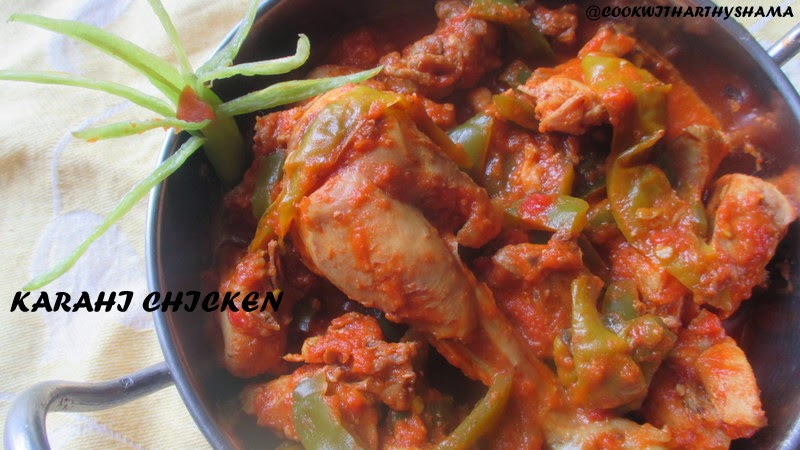
Karahi chicken

   'Karahi Chicken', an Pakistani dish, derives its name from the round, circular shaped wok (called as karahi) they are cooked with.   Prepared with tomatos and green chilly as its base, this gravy is not only flavourful, but also was delecious.  


With an toddler around, I decided to go with moderate amounts of green chilly (If you wish this dish to be highly spicy, you can add more amount of green chillies) Remaining amount of green chilly, was substituted with capsicum slices to give an sweet touch.  This dish, is cooked as an one pot meal and traditionally was cherished till late nights.  Simplistic approach, with easy-peasy ingredients and no-oil cooking complements this dish an lot.

Saturday, 31 May 2014

Araichu vitta sambhar

Running out of sambhar powder?  Or often wondering the secret-ingredient for restaurant-styled thick sambhar??   Don't worry.... this, araichu vitta sambhar comes to your rescue :D  'Araichu vitta' in tamil means freshly grounded, accordingly this sambhar utlizes an medley of spices from your kitchen, that are freshly dry-roasted and powdered.  This powder, not only comes in handy when your sambhar powder goes out of stock, but also acts as an, 'thickening agent', thus making the latter more fragrant, more tasty and restaurant-styled.


And, one other difference from sambhar is that, in araichu vitta sambhar, tempering is done by the end.  Since, we add no spices other than dry-roasted ones, we may not be sure about the spice- content of sambhar.  Hence, tempering accordingly with number of red chillies might yield you an perfect, balanced output.  This is really, an blessing in disguise, isn't it? 

nRelate Posts Only